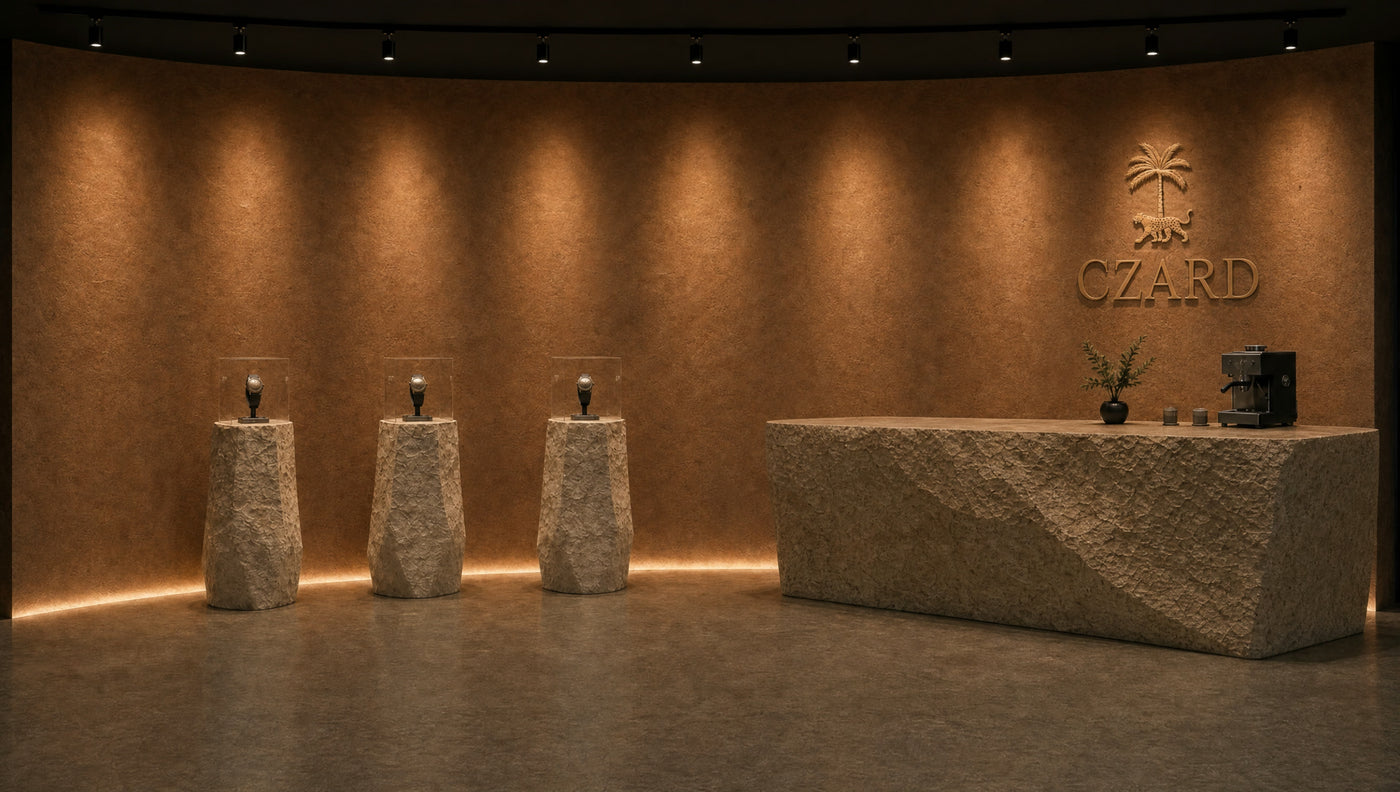
A predator beneath a palm tree is an unusual sight. As the mark of a watchmaker, it is more unusual still.
Most emblems communicate a single idea. The CZARD mark does not. It pairs two symbols that appear to belong to different worlds: a panther, poised in motion, and a palm tree, rooted in place. Together, they ask a question rather than offer an answer.
Why would a watchmaker choose them?
The answer has little to do with wildlife or landscape. It has everything to do with character.
Before a watch is appreciated for its movement, finishing, or proportions, it belongs to a company that has decided what it wishes to stand for. The Palm and Panther became that decision made visible. They do not promise status or claim superiority. They suggest something quieter: that ambition, however necessary, is incomplete unless it knows what it exists to achieve.
Every meaningful pursuit eventually reaches the same question.
What is the pursuit ultimately for?
The answer begins with the panther.
The Panther
History is filled with powerful animals. Lions guarded kingdoms. Eagles represented empires. They were chosen because they projected authority before a single word was spoken.
The panther earned its place differently.
Its reputation has never depended on spectacle. It is admired for restraint.
A panther rarely wastes movement. It does not chase every opportunity that appears before it. It observes, waits, and moves only when movement has purpose. That patience should never be mistaken for hesitation. It is confidence expressed through judgement rather than urgency.
The panther understands something modern life often forgets.
Movement is not the same as progress.
Being occupied is not the same as moving forward. Speed has little value when the destination has never been considered.
This is why the panther continues to fascinate. Not because it is the strongest predator. There are larger animals. Not because it is the fastest. There are quicker hunters.
It is admired because nothing about it is unnecessary.
Every action prepares for the next.
Nothing is wasted.
That same discipline defines exceptional craftsmanship. A master watchmaker does not add another component simply because there is room for one. An engraver does not fill empty space because silence feels uncomfortable. A designer does not enlarge a case simply because larger has become fashionable.
Judgement begins where excess ends.
The panther embodies that principle. Its ambition is measured rather than restless. Its confidence comes from precision rather than attention. It pursues excellence without feeling compelled to announce the pursuit.
For CZARD, that distinction mattered.
The mark was never intended to celebrate aggression or domination. It represents disciplined pursuit: the willingness to move deliberately towards something worth achieving.
Yet even the panther has its limitation.
A pursuit without a destination eventually becomes an endless journey. Achievement alone can become another habit, another race that never truly finishes.
The hunt can continue forever if nothing tells it when to stop.
That answer does not belong to the panther.
It waits beneath the palm.
The Palm
If the panther represents the pursuit, the palm represents the reason the pursuit exists.
Unlike the panther, the palm has no need to chase anything. It grows where it belongs, enduring through changing seasons while the world around it continues to move. Its character is defined not by speed, but by permanence.
For centuries, the palm has represented arrival rather than conquest. People have admired it not for its strength, but for what it offers: shade after a long journey, rest after effort, and the quiet assurance that the destination has finally been reached.
Across cultures, it has come to symbolise fulfilment. Not the absence of ambition, but the moment ambition has accomplished what it was meant to accomplish.
Modern life rarely encourages that distinction.
Achievement is often treated as an endless sequence of objectives. Every success becomes another beginning. Every milestone gives way to another ambition. Progress continues, but satisfaction quietly retreats beyond the horizon.
The pursuit never ends.
The destination disappears.
The palm interrupts that cycle.
It asks a question that ambition often avoids.
Has success created a better life or merely a busier one?
That may be the quieter question.
It is also the more difficult one.
The palm was never chosen to represent leisure or escape. It represents perspective. It reminds us that achievement should ultimately create something beyond itself: time to appreciate, freedom to choose, and the presence to enjoy what has already been earned.
Within the CZARD mark, the palm completes what the panther begins.
Without purpose, ambition becomes endless motion.
Without ambition, purpose remains only an intention.
Where They Meet
The most memorable emblems often communicate a single idea.
The Palm and Panther communicate a relationship.
The panther embodies the discipline to pursue.
The palm reminds us why the pursuit matters.
Together, they reject a familiar misunderstanding: that success is measured only by constant movement.
Behind every worthwhile pursuit lies something quieter than ambition itself: a family, a craft, a conviction, or simply a life imagined long before it was lived. Those are the things that give ambition its meaning.
The Palm and Panther exist to keep those ideas together.
The tension between movement and stillness, pursuit and fulfilment, discipline and freedom is never fully resolved. It is negotiated throughout a lifetime.
That is what the mark quietly acknowledges.
It does not celebrate ambition over fulfilment, nor fulfilment over ambition.
It suggests that each is incomplete without the other.
For CZARD, this philosophy extends beyond symbolism. It shapes the way every timepiece is conceived, balancing technical precision with restrained design so that every detail serves a purpose rather than competing for attention.
If you'd like to explore how this philosophy is expressed in the collection itself, the story continues through the watches that carry the Palm and Panther.
Why This Mark Belongs to a Watchmaker
The Palm and Panther could have belonged to many kinds of brands.
They became the mark of a watchmaker because the philosophy they express already exists inside the movement that powers it.
CZARD's watches run on the VK61, a mech-quartz movement: quartz-driven for precision, engineered with a mechanical module that gives the chronograph pushers real resistance and the chronograph seconds hand a smooth sweep when running. It borrows the feel of a mechanical chronograph without carrying its unnecessary complexity.
That is restraint applied to engineering rather than decoration. The VK61 doesn't chase complication for its own sake. Every part of it exists to do one thing precisely rather than many things adequately.
Precision is not achieved by adding more. It is achieved by controlling what's there with consistency and intent.
The relationship between the Panther and the Palm follows the same logic. The panther represents the determination to move forward. The palm ensures that movement serves something beyond the pursuit itself.
This philosophy is reflected not only in the mark, but in the watch that carries it. Every detail is a considered choice rather than excess, in proportion, in finishing, and in the movement itself.
Luxury has never been created through abundance. It has always been created through judgement. Knowing what deserves to remain. Knowing what should be left behind.
That is what the Palm and Panther represent. Not simply a visual identity. A way of thinking that guides every decision, from the philosophy behind the brand to the watch itself.
The finest marks are not remembered because they demand attention. They are remembered because they continue to reveal meaning long after recognition has become familiarity.
The Palm and Panther were created with exactly that intention.
Frequently Asked Questions
What does the Palm & Panther represent?
The Palm & Panther is the emblem of CZARD, bringing together disciplined pursuit and purposeful fulfilment. Together, they reflect the belief that ambition finds its greatest meaning when guided by purpose, shaping the way the brand approaches both watchmaking and design.
Why did CZARD choose the Palm & Panther as its emblem?
The Palm & Panther was never conceived as a decorative logo. It emerged from the conviction that shaped CZARD itself. Neither symbol tells the complete story alone, but together they express the balance between determination and fulfilment that defines the brand.
Where can the Palm & Panther be found on a CZARD watch?
The Palm & Panther appears on the signature caseback medallion of every CZARD timepiece. Positioned above the movement, it serves as a quiet reminder that the philosophy behind the brand and the engineering within the watch are guided by the same principles.
Will the Palm & Panther remain part of CZARD?
Yes. The Palm & Panther is the enduring emblem of CZARD. It will remain a constant across every collection, reflecting the philosophy that defines CZARD and the watches it creates.
What does the Palm & Panther reveal about CZARD?
It reveals a belief that craftsmanship begins with judgement. Every meaningful creation is shaped not only by what is included, but also by what is deliberately left out. The Palm & Panther expresses that philosophy before a single watch is ever placed on the wrist.
The Palm and Panther appear on every CZARD timepiece as a reminder that exceptional watchmaking is shaped as much by judgement as by precision